
At Kelley Blue Book, we are lucky enough to have access to a large inventory of brand-new vehicles for evaluation each year, putting them through thousands of miles and experiencing a slice of life with them. Our time with each is usually problem-free while satisfying our editorial needs, but we are not immune to the outside world when we hop inside and take them out on the road. Living near downtown Atlanta, Georgia, I am now more painfully aware of this after a fender bender in heavy traffic earlier this year.
Here’s What Happened
Immediately, you should know that there was no real pain involved, as the incident wasn’t even consequential enough to set off any airbags. Both parties drove away without injury.
What happened? I was driving the 2026 Mazda3 sedan, a fully loaded Turbo Premium Plus trim, in a northbound right-hand lane of a major thoroughfare near Georgia Tech’s campus, intending to turn east at an upcoming four-way intersection.
Because I was driving during a peak Atlanta traffic window, a line of cars had already formed on the perpendicular road I planned to turn onto. As a compact sedan, the Mazda3 is a great size for city-dwellers who must regularly deal with tighter margins, and in my case, there seemed to be just enough room for me to make most of the right turn and nestle myself up against the last car in the line. The Mazda’s rear end, however, could not fully clear the original northbound lane, so I sat there putting my trust in the attentiveness of the other drivers following behind me at over 35 mph.
That trust was broken when, a couple of hundred yards back, a driver in a Hyundai Veracruz (predecessor to the Santa Fe 3-row) was not paying close enough attention and was forced to swerve at the last second to avoid hitting me, even after I had been stationary there for an ample amount of time for them to take action.
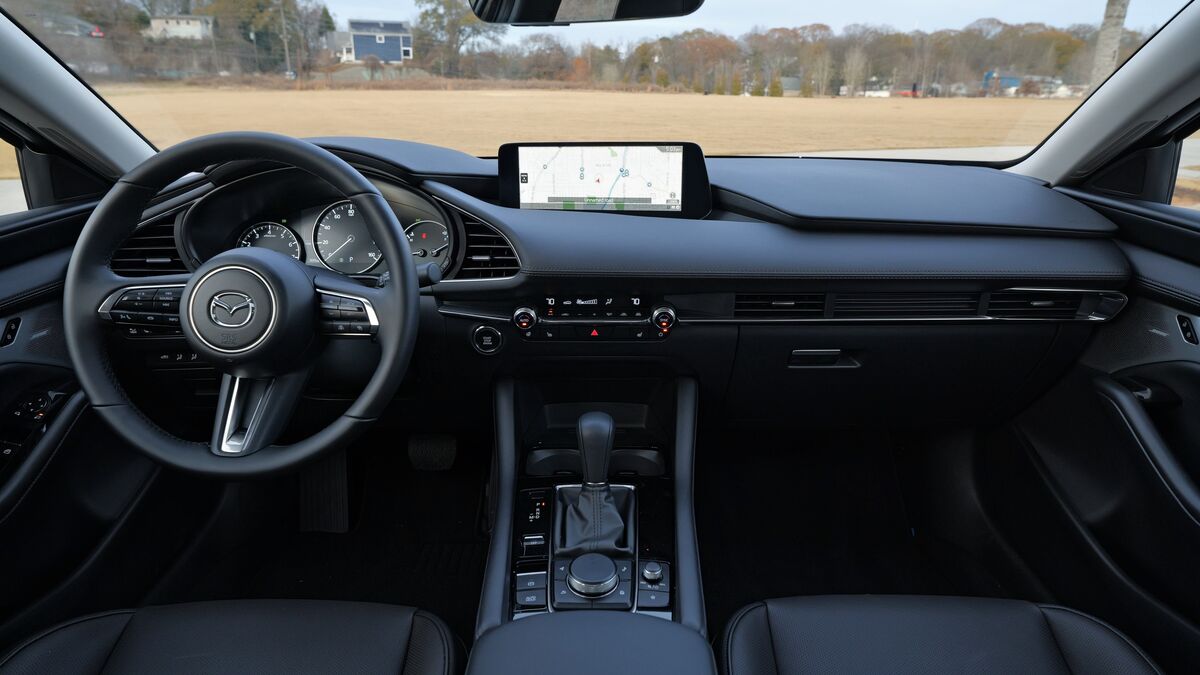
Mazda equips all Mazda3 models with blind-spot monitoring and rear cross-traffic alert. The latter is used when backing up into perpendicular traffic, alerting you if a moving object is approaching from either direction. The blind-spot monitor is for when you are driving forward down a multi-lane corridor. It indicates if someone is approaching you from behind in either the adjacent right or left lane by flashing a light in the appropriate side mirror.
Here, the Hyundai driver swerved left to avoid the impending collision, but because of the angle my car was at, the BSM didn’t detect them until the last second. By the time I could focus on what was coming through the mirror, they were colliding with the left rear side of the trunk. The Veracruz couldn’t move any further to the left to end the contact or more collisions would have occurred, so its entire right side ended up marred by the Mazda.
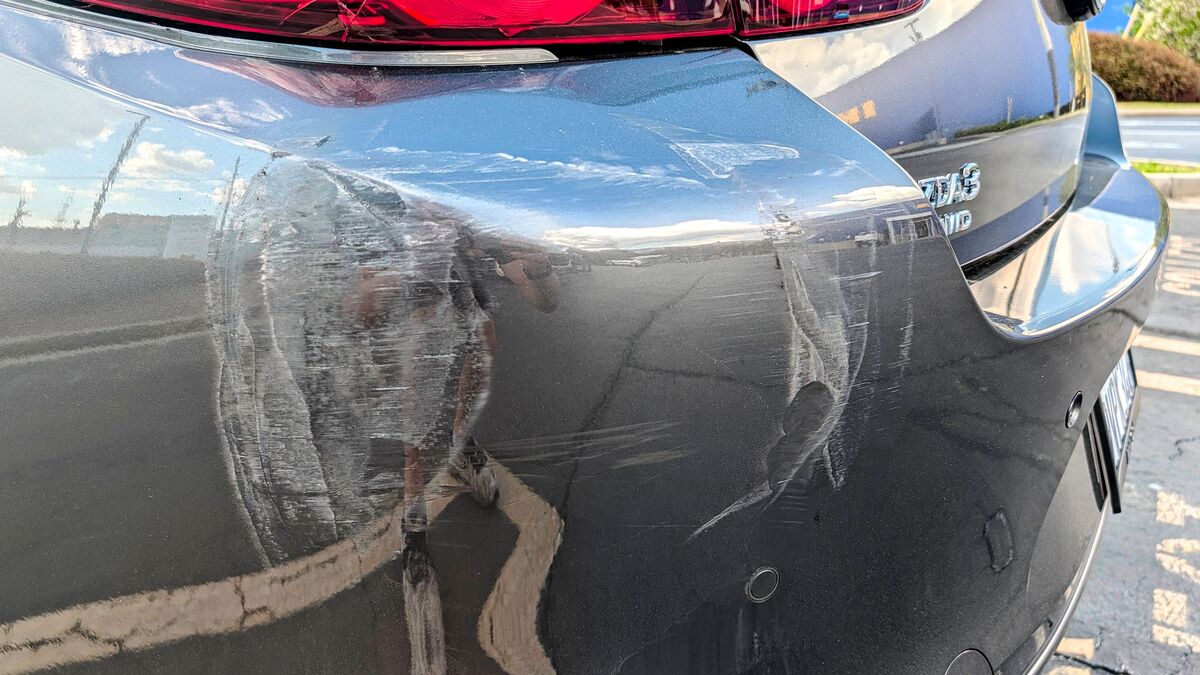
Luckily, I was able to leave my spot and follow them to a nearby parking lot, where the police were called, and the other driver was ultimately found to be at fault. Once the paperwork was completed, we were both able to drive off, with each car operable.
You might be wondering: What were my responsibilities regarding documentation and insurance? This part was relatively easy, seeing that I did not hold any liability for the incident. The fleet management companies that loan us these vehicles hold their own insurance on the cars. All I had to do was fill out the police form and the insurance form the fleet company keeps in the glove box of every vehicle. Once those were submitted, I had to report the incident internally to Kelley Blue Book parent Cox Automotive, but it was out of my hands after that.
Prevention Is Ideal
This incident reminded me of a tour our department took of the Insurance Institute for Highway Safety (IIHS) headquarters in Virginia a few years back. There, we got to see the 1959 Chevy Bel Air that was used in the infamous Bel Air vs. 2009 Chevy Malibu overlapping crash test video. The Bel Air was more or less destroyed, while the Malibu was still drivable, a sobering reminder that automotive engineering has come a very long way.
Still, the best way to handle an accident is to prevent it in the first place. And technology for that has come a long way, too. From the 2008 to 2012 model years, the Hyundai Veracruz was the company’s first attempt at an alternative to the Toyota Highlander. Just a few years shy of receiving Hyundai’s first implementation of autonomous emergency braking systems, it was discontinued, leaving it with no such active safety system for instances like this.
Had the roles been reversed, the Mazda3 might have been able to prevent the accident entirely. All 2026 Mazda models come with Smart Brake Support, which audibly and visually alerts the driver to impending front collisions and can intervene when necessary. Such automatic emergency braking systems have become standard fare in most new vehicles sold today, evolving into a very effective safeguard for today’s distracted driver. That’s certainly something to consider when shopping for your next vehicle.